N4WIS Radio Shack
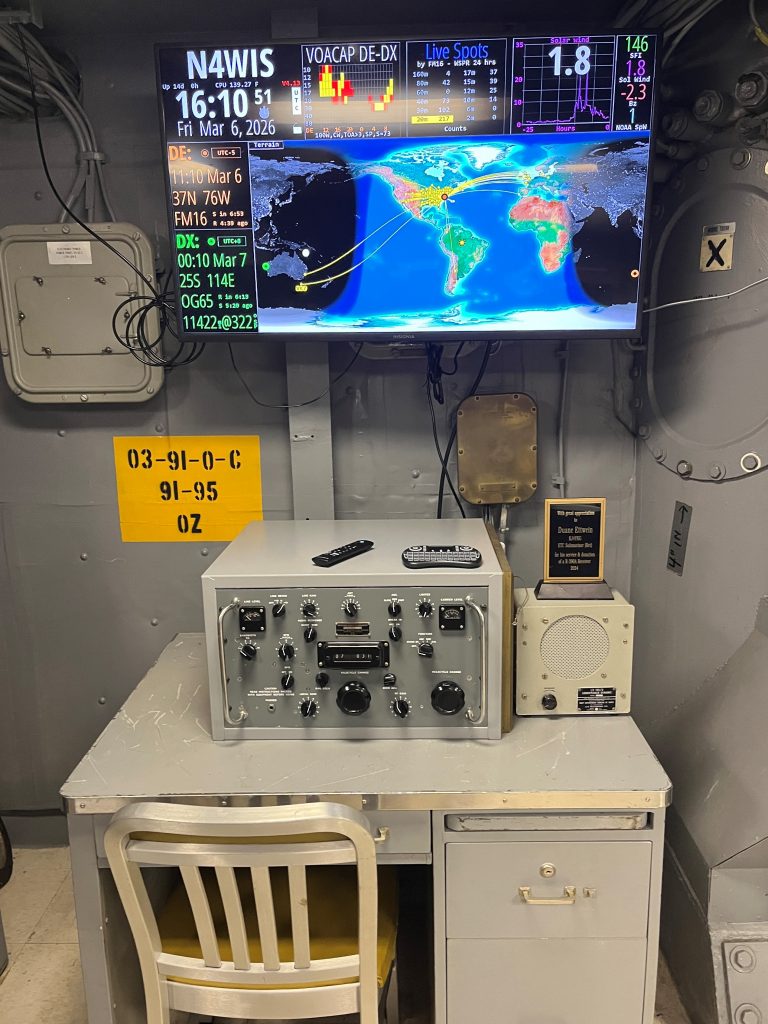
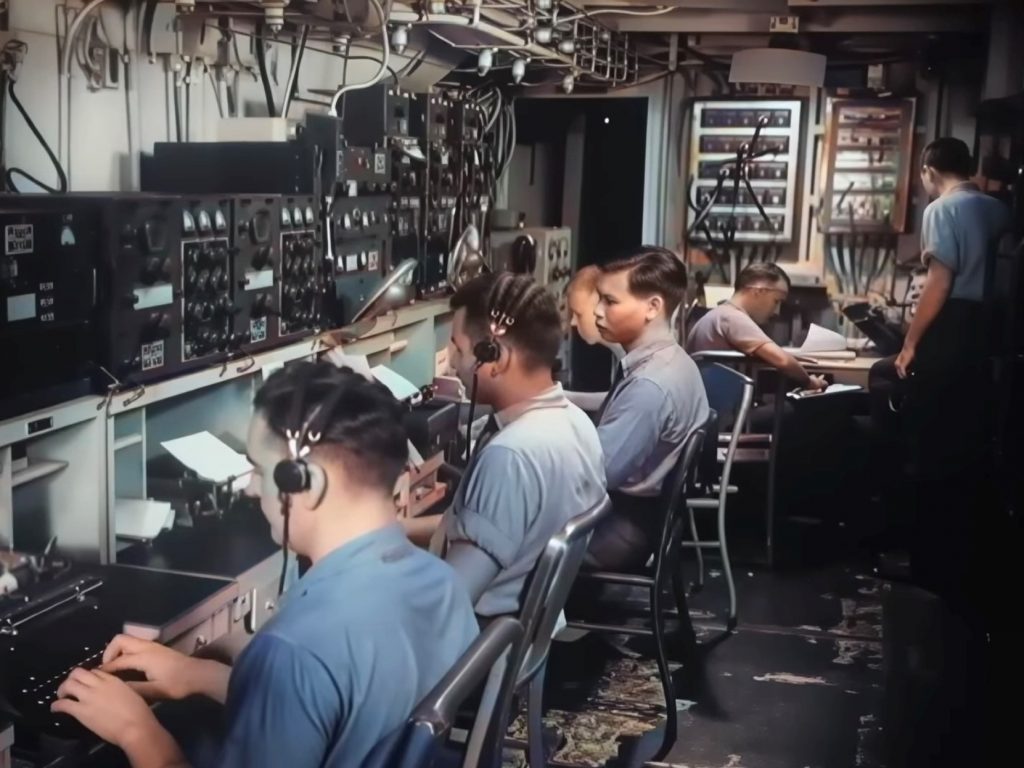
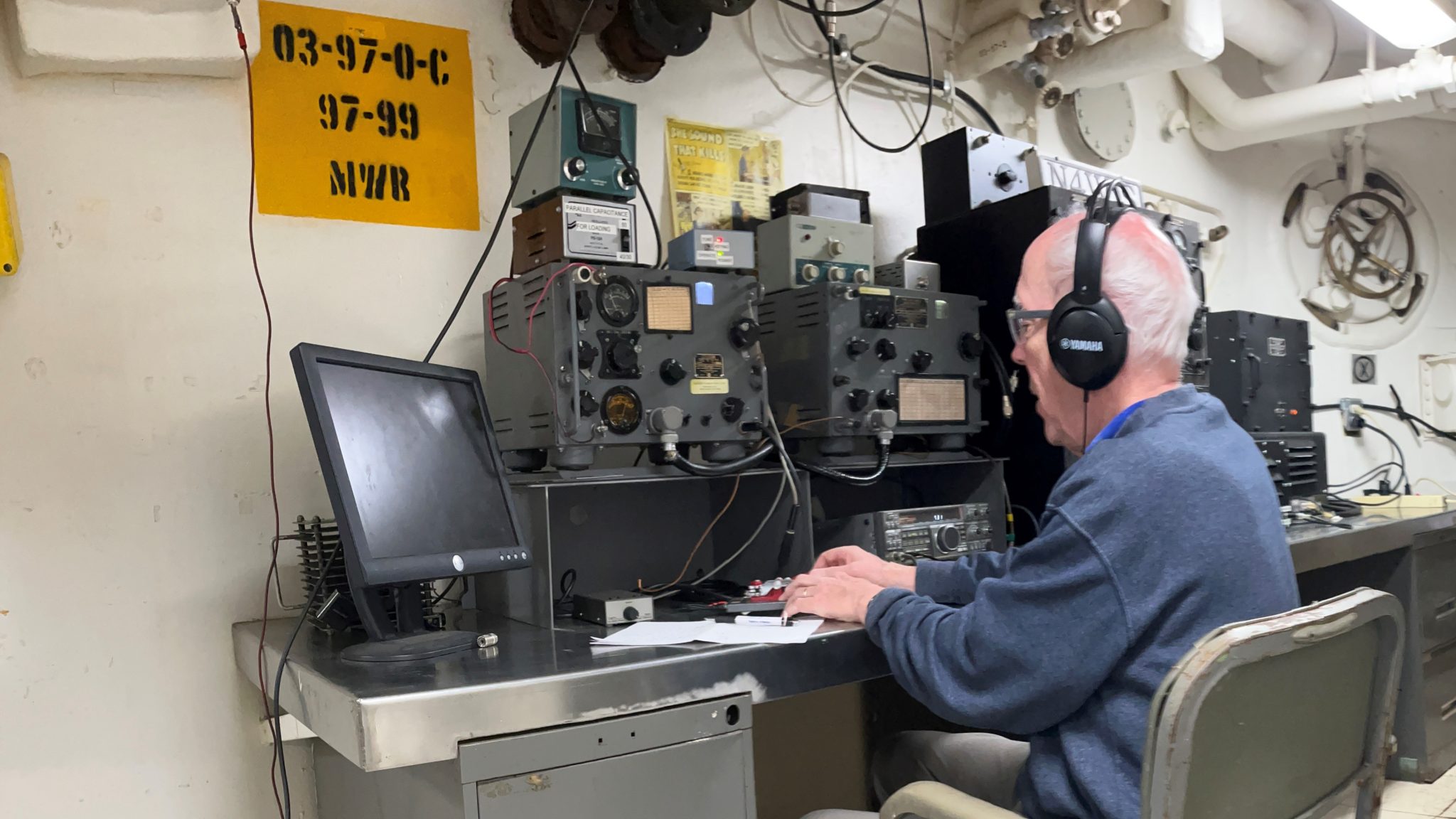
The USS Wisconsin Radio Club maintains a collection of restored naval radio equipment representing several eras of communications technology. Some equipment dates to World War II and is similar to radios used aboard U.S. Navy ships during the war.
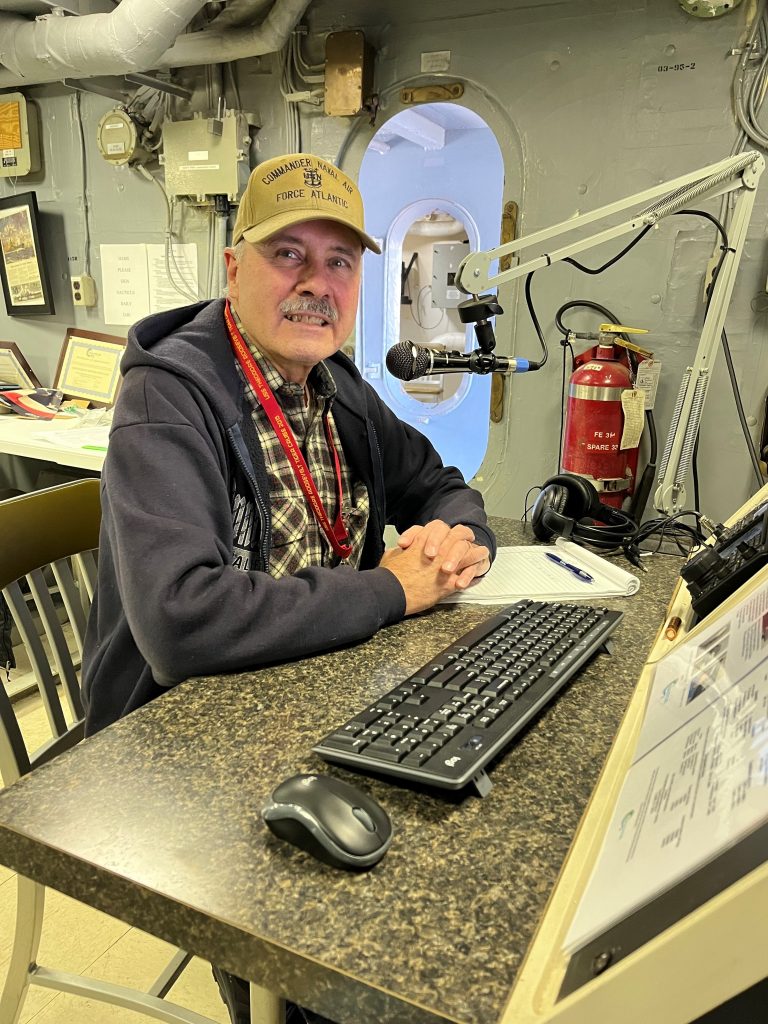
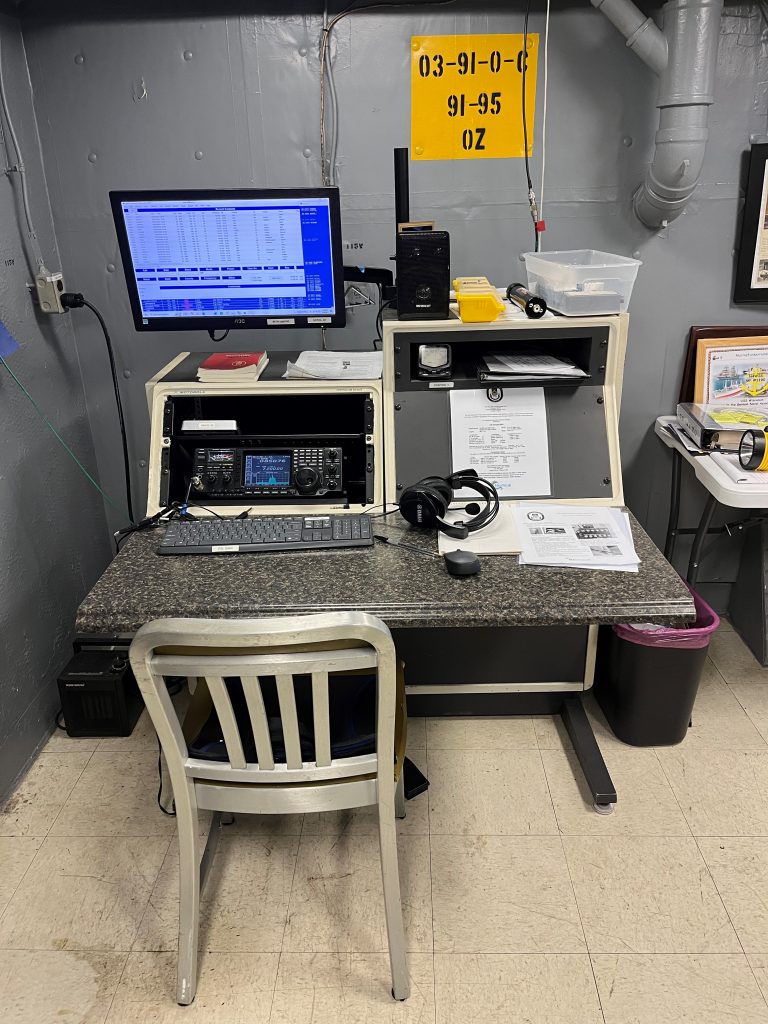
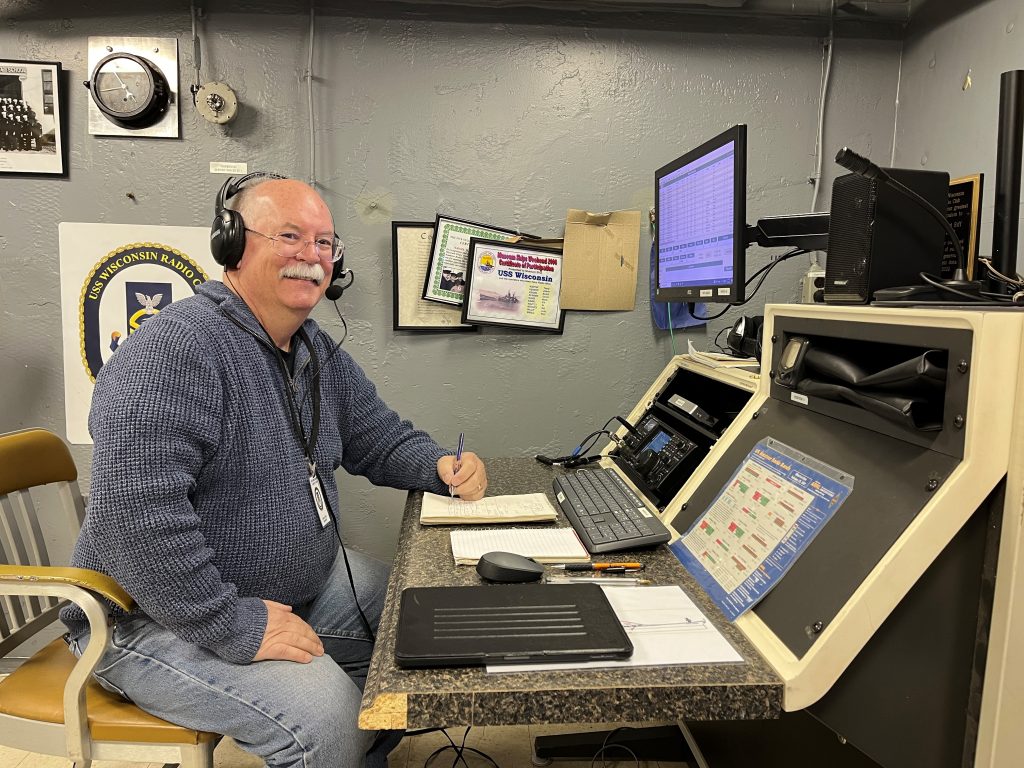
Today the club operates amateur radio station N4WIS aboard the historic battleship USS Wisconsin.
World War II Era Radio Equipment
Open video
Collins TCS-12 Transmitter and Receiver
Collins Radio Company — Cedar Rapids, Iowa
Compact Power for Naval Communications in WWII
The TCS-12 is a matched high-frequency (HF) transmitter and receiver set produced by the Collins Radio Company for the U.S. Navy during World War II. Designed for rugged maritime service, it provided continuous-wave (CW) and amplitude-modulated voice operation across three HF bands (1.5–3 MHz, 3–6 MHz, and 6–12 MHz), enabling long-distance ship-to-shore and inter-vessel communications using an external dynamotor-powered supply. The system was widely deployed aboard landing craft, PT boats, smaller naval vessels, and shore stations, where its reliability, frequency agility, and robust construction supported tactical naval communications throughout the war and into the early post-war period.
Frequency Coverage:
1.5–12 MHz (three switched bands)
Modes:
CW and AM voice
Power Output:
CW: ~25-40 watts RF; AM: ~10-20 watts RF
Power Supply:
External dynamotor supply
Open video
Magnavox Navy RAL-8 HF Regenerative Receiver
The Magnavox Company — Fort Wayne, Indiana
Built to Copy Weak Signals Across the Wartime Airwaves
The RAL-8 is a regenerative high-frequency communications receiver manufactured by The Magnavox Company and widely used by the U.S. Navy during World War II. Part of the Navy’s RAL series, it covered approximately 300 kHz to 23 MHz across multiple switched bands, allowing reception of longwave, medium-wave, and high-frequency signals vital to maritime operations. The rugged shipboard receiver employed a five-tube regenerative design with band-switched internal coils, adjustable feedback for CW and AM reception, and a crystal filter to improve selectivity. Installed aboard numerous naval vessels and shore stations, the RAL-8 provided reliable communications and monitoring capability under wartime conditions and remains a notable example of mid-20th-century naval radio engineering.
Frequency Coverage:
~300 kHz – 23 MHz
Circuit Type:
Five-tube regenerative receiver
Modes:
CW and AM reception
Notable Features:
Band-switched coils, adjustable regeneration, crystal filter
Open video
RCA Navy RAK-7 VLF/LF Regenerative Receiver
Radio Corporation of America (RCA) — Camden, New Jersey
The Fleet's Long -Wave Listener
The RAK-7 is a U.S. Navy very low frequency (VLF) and low frequency (LF) regenerative receiver built by RCA for World War II shipboard and submarine service. Using a tuned-radio-frequency (TRF) design with a regenerative detector, it provided high sensitivity with rugged, straightforward circuitry. Covering roughly 15 kHz to 600 kHz in six bands, the RAK-7 supported long-range naval communications, beacons, and shore-to-ship links—often paired with the RAL receiver to extend coverage upward into HF.
Frequency Coverage:
~15–600 kHz (six bands)
Circuit Type:
TRF with regenerative detector
Primary Use:
Long-range VLF/LF naval reception
Companion Set:
Often paired with RAL (HF)
Open video
Scott Radio Laboratories RBO Receiver
E. H. Scott Radio Laboratories — Chicago, Illinois
Keeping the Fleet Tuned to the War
The RBO receiver was designed by Scott Radio Laboratories for U.S. Navy shipboard entertainment during World War II. Built to strict “low-radiation” standards so its local oscillator would not interfere with direction-finding or communications equipment, the superheterodyne receiver covered the medium-wave broadcast band and two shortwave ranges from about 5.5 to 15.6 MHz. Installed in shock-mounted cabinets aboard many naval vessels, the RBO provided reliable reception of music and news broadcasts, helping sustain crew morale during extended wartime deployments at sea.
Frequency Coverage:
~540–1600 kHz; 5.55–9.55 MHz; 9.20–15.60 MHz
Circuit Type:
Superheterodyne receiver
Primary Purpose:
Shipboard entertainment and broadcast reception
Design Feature:
Low-radiation circuitry to avoid DF interference
Post-War / Cold War Equipment
Open video
Collins R-390A (R-390A/URR) HF Communications Receiver
Collins Radio Company — Cedar Rapids, Iowa
The Gold Standard of Military HF Receivers
The R-390A/URR is a rugged general-coverage high-frequency communications receiver developed for the U.S. military by Collins Radio Company in the 1950s. Designed for exceptional sensitivity and selectivity in CW and AM reception, it covered approximately 0.5–32 MHz using a complex multi-conversion superheterodyne design with mechanical filters and a mechanically tracked tuning system. Deployed widely across U.S. Navy ships, shore stations, and other military facilities, the R-390A became a Cold War workhorse receiver valued for its reliability, serviceable modular construction, and outstanding performance.
Frequency Coverage:
~0.5–32 MHz
Circuit Type:
Multi-conversion superheterodyne
Vacuum Tubes:
≈26 tubes
Notable Feature:
Mechanical IF filters and precision gear-driven tuning
Modern Amateur Radio Station N4WIS
Open video
FlexRadio FLEX-6500 Software-Defined Transceiver
FlexRadio Systems — Austin, Texas
HF / 50 MHz software-defined amateur radio transceiver
The FLEX-6500 is a modern software-defined HF and 6-meter transceiver developed by FlexRadio Systems in the 2010s. Using direct digital sampling, the radio converts RF signals to digital data at the antenna and processes them in software, providing high receiver performance, flexible filtering, and real-time spectrum displays. Covering roughly 30 kHz to 72 MHz and transmitting up to 100 watts on amateur bands from 160 m through 6 m, the FLEX-6500 combines traditional radio operation with network-based control through SmartSDR software.
Frequency Coverage:
~30 kHz – 72 MHz receive
Transmit Bands:
160 m – 6 m amateur bands
Output Power:
100 watts
Architecture:
Direct-sampling software-defined radio (SDR)
Open video
Icom IC-756PROII HF / 50 MHz All-Mode Transceiver
Icom Incorporated — Osaka, Japa
Precision HF Performance in Every Contact
The IC-756PROII is a high-performance amateur radio transceiver introduced by Icom in the early 2000s, covering all HF amateur bands and the 6-meter band with 100-watt transmit capability. Its 32-bit IF-DSP architecture provides advanced filtering, noise reduction, and digital signal processing, while a large color spectrum display allows operators to visualize band activity and tune signals quickly. Combining modern DSP techniques with traditional radio controls, the IC-756PROII became a popular choice for club stations and serious operators seeking versatile HF and 6-meter performance.
Frequency Coverage:
~30 kHz – 60 MHz receive
Transmit Bands:
160 m – 6 m amateur bands
Output Power:
100 W
Key Feature:
32-bit IF-DSP with real-time spectrum scope
Open video
ZachTek WSPR Desktop Transmitter
ZachTek — Sweden
Tiny Transmitter, Global Reach
The ZachTek WSPR Desktop Transmitter is a specialized low-power beacon designed to transmit WSPR signals for studying long-distance radio propagation. Operating at extremely low power—often milliwatts or less—it produces highly stable, narrowband digital transmissions that can be received far below the noise floor at great distances. Used by amateur radio operators and researchers worldwide, WSPR beacons help map ionospheric conditions, evaluate antenna performance, and study the effects of solar and geomagnetic activity on global radio communication.
Operating Modes:
WSPR digital beacon
Typical Power:
milliwatts to sub-milliwatt
Primary Purpose:
Radio propagation research
Operation:
Continuous automated transmission
Gallery